12 steps to rewilding land
A practical guide for individuals, communities or organisations considering land-based rewilding in Britain.

Rewilding is a journey with no fixed endpoint. The goal is to help nature help itself so it can thrive into the future. There鈥檚 not a defined set of actions to take. What you do will depend on your finances, your ambition, the size of your land, the state of your soils and water, the features in your landscape, your neighbour鈥檚 activities and so much more.
If you follow our five principles of rewilding you won鈥檛 go far wrong: engage people and communities as much as possible, let nature lead, look to create opportunities for resilient new nature-based economies, work at nature鈥檚 scale to rewild whole systems and not just fragments, and work to ensure that your rewilding project is for the long-term, for the benefit of future generations.
While we can鈥檛 tell you exactly what to do, our 12 steps can guide you down the right path. Follow these, where and when you can, and you鈥檒l be on your way to rewilding
If you鈥檙e looking at rewilding within a coastal community, take a look at our marine rewilding guide.
12 steps to rewilding land
Don鈥檛 dive in head first with a chainsaw/bunch of tree saplings or compendium of deer/cattle/sheep/pigs/horses (delete as appropriate). If you鈥檝e just purchased land, or you鈥檝e been managing it in a particular way, then leave it be while you work out what you want to do. This is true whether it鈥檚 arable land, woodland, a thicket of thorns and brambles or a collection of fields. We know you're eager to get going, but it's important to remember that nature works best at different timescales to humans, and many of the ecosystem processes you'll be working to restore act over decades. One year of observation will ensure you don't miss anything important.
You will learn something about your land simply from waiting and watching, and while you鈥檙e waiting you can move on to step 2鈥�
Whilst undertaking the "do nothing" phase, it's a good time to find out what you have on your land. Is your woodland ancient? Is that special species-rich grassland growing over there? Why鈥檚 that field flooding? A proper inventory of what you have, and what鈥檚 going on, will reveal important habitats and wildlife features, the state of your soils, important geological and hydrological features, any archaeological features, seed sources and more.
There are two good reasons for doing this:
1. To inform your decision-making and planning, and
2. To ensure you鈥檙e not destroying anything valuable.
Observing your land for 12 months will give you a good idea of what is happening each seasons. In addition, information may already exist 鈥� for example, biodiversity data and information related to ecosystem services such as carbon storage, flood risk, water quality and soil condition. You need to find out where it is, who owns it and whether you can access it. You can start doing this yourself (see Gathering information about your land). But if it鈥檚 too far out your comfort zone, or you just don't have the time, then you鈥檙e ready for step 3鈥�
You need to find someone with expertise and knowledge 鈥� especially for large-scale rewilding projects. Ecologists can help you understand what鈥檚 on your land and can help you navigate publicly available resources 鈥� such as regional biodiversity records and DEFRA鈥檚 MAGIC mapping of the natural environment. You can enlist help and expertise from a local rewilding group. Check out our Rewilding Network to see who鈥檚 in your area. Other local conservation groups, including Wildlife Trusts, are also buzzing with enthusiasts able and willing to help nature-boosting projects like yours. You can hire an accredited ecologist via , the professional body for ecologists.
Then it鈥檚 time to look beyond your own boundaries and go to step 4.
Look at the land outside of your site to see what鈥檚 there. Talk to your neighbours about what they鈥檙e doing and what you want to do. Find out if they share your rewilding ambitions or might with a bit of encouragement. Consider some specifics. Can you connect those disparate pieces of woodland? Could you give access to a neighbour鈥檚 grazing animals? If you鈥檙e bordering a nature reserve or a designated site, can you help create a larger space for wildlife?
Connectivity and scale is crucial in nature. Connecting up rewilding areas and conservation sites gives wildlife the best chance to thrive. It鈥檚 good for people too 鈥� you can support each other while supporting the rebuilding of ecosystems. The larger the area you鈥檙e rewilding, the less management is required and the more you can relax and let natural processes lead the way.
If you own a smaller area of land, we encourage neighbours to form rewilding clusters whenever possible. Clusters are groups of landowners who have shared ambitions to rewild their land, and help to deliver rewilding at scale across their property boundaries. Learn about the Devon Rewilding Cluster.
You need a plan. It can be in your head, or it can be a beautifully constructed document with the i鈥檚 dotted and the t鈥檚 crossed. But try to have an idea of what actions you want to take. Rewilding is not about having targets and end-goals in mind; it鈥檚 about helping nature do its thing and go its own way as much as possible. You need to determine and plan the interventions that will help restore the missing ecosystem processes and kick-start rewilding. Think of it as a marathon with a sprint start. Rewilding is a long-term commitment, but you want to restore as much as you can to get things going.
You might want to go back to step 3 and get that expert to help you. And keep in mind that the next step lies at the heart of rewilding鈥�
This is absolutely the key to rewilding. You need to understand what natural processes are and which natural processes may re-establish on your land 鈥� with or without a helping hand. This includes tree regeneration, natural river processes and flooding regimes and natural grazing levels.
Human actions have suppressed natural processes across most of Britain over the centuries. If hundreds of sheep have grazed your land for decades, if rivers have been straightened or wetlands drained, or if woodlands have been felled, then nature has been altered and constrained and natural processes no longer prevail. Rewilding is about unleashing the power of nature and helping it when needed.
How can you help? You can read about restoring natural processes and then take inspiration from step 7. Use time during your "do nothing" phase to study ecosystem processes and learn about what's missing on your land, or appoint an ecologist to guide your project who will already understand this.
Rewilding lets nature drive its own recovery. But we鈥檝e lost our large herbivores, such as elk, wild boar and bison, and key predators, such as wolf and lynx. Grazing and predation, two important natural processes, are therefore limited. However, pigs and cattle can act as proxies for wild boar and the extinct aurochs. Harvesting the large herbivores can emulate the impact of large predators.
On small sites, imagine it as part of a magnificent species-rich landscape. You could scythe grass to mimic the grazing of aurochs as they pass through, or hoe up ground to mimic a boar鈥檚 rootling. Nature is complex and complicated, though. It鈥檚 not possible for humans to perfectly replicate natural functioning ecosystems without the full complement of key native carnivores and herbivores being present. Still, we can move a long way up the rewilding spectrum if we seek to mimic natural processes where we cannot restore them.
Then get ready to go for the real thing with step 8.
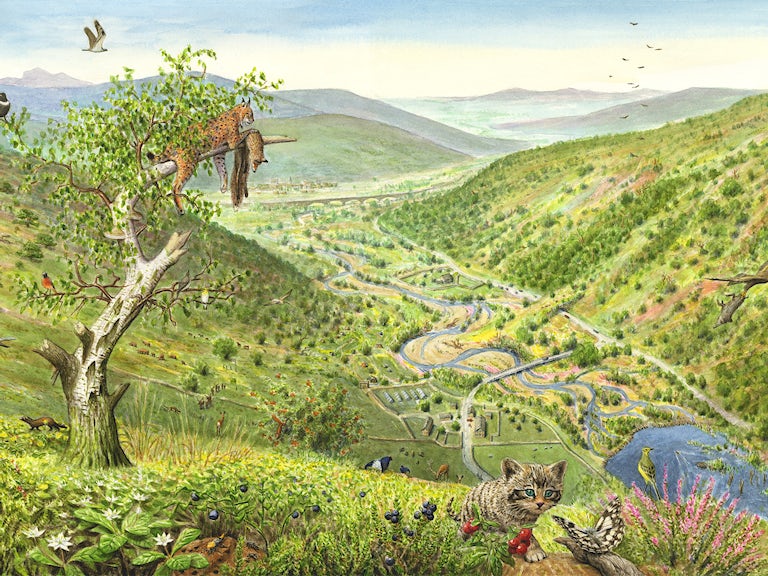
Simply restoring habitats and natural processes will bring back many species that have disappeared from your land. For example, the creation and restoration of wetland habitats has led to the remarkable recovery of bird species, insects, fish and mammals. Reducing grazing pressure in upland rewilding sites has seen the amazing recovery of rare and precious plant communities, including the Caledonian pinewood.
Restoring populations of native species near the top of the food chain will still be a priority in many rewilding sites, especially the large-scale projects. We鈥檝e hunted species to extinction, including wolf, lynx, beaver, bear, wild boar and elk. And we鈥檝e pushed others to the brink 鈥� the wildcat, white-tailed eagle and hen harrier, for example.
Reintroductions can bring some species back. Beavers, red kites and white-tailed eagles have been reintroduced in Scotland and England in recent years. Water voles, red squirrels and pine martens have been translocated to help restore their populations more widely.
If you have land that鈥檚 suitable for a reintroduction, it鈥檚 certainly something to consider. However, keep in mind that reintroductions require licenses and adherence to careful procedures, so you鈥檒l need expert help.
For more context on reintroductions, read Reintroductions and bringing back species.听
Rewilding is about helping nature to work on its own terms. It鈥檚 a journey of learning and unlearning, of embracing change and surprise, of delight and sometimes disappointment. Some species of wildflower may disappear from an area where you have known them to be for years, but when changes in grazing regimes take hold, they may pop up elsewhere. Other species, which you have never seen on your site nor ever expected, may suddenly appear and start to flourish.
Of course, if you have something really special on your site 鈥� such as an area of unimproved chalk grassland covered in rare wildflowers 鈥� you should strive to protect it. In steps 1 & 2, you identified and mapped areas that need special conservation management and/or where legal requirements are in place. It's very likely that over time these plant communities will appear elsewhere in your site. When they do, you can be more relaxed about conserving them at their original location.
A good motto to remember here is 鈥榗onserve the very best and rewild the rest鈥�. Rewilding embraces the complexity of nature so don鈥檛 be afraid of change, and do be prepared to adapt your thinking over time. And as the story of your land begins to unfold and surprise you should record what happens, which leads us nicely to step 10.
Rewilding is not about targets 鈥� this many trees by 2050 or this many nightingales by 2030. It鈥檚 a continuous journey of letting nature ebb and flow with minimal intervention once you've restored as many processes as possible. But you should record what鈥檚 happening on your land. It enables you to understand what鈥檚 happening and share stories of what鈥檚 happening. That helps all of us learn. We鈥檝e lost so much knowledge, and as rewilding projects across Britain record the changes they observe, we can all start to understand what's possible.
You can enlist expert or volunteer help with your monitoring or get stuck in yourself. Our Measuring and monitoring guidance can help keep you right. We're also developing a聽Rewilding Monitoring Framework to help guide projects on key aspects of rewilding to measure and how you might do it. We鈥檒l be rolling this out initially with members of the Rewilding Network in autumn 2024.
Rewilding shouldn鈥檛 be a solitary pursuit, although it鈥檚 okay if you want it to be. There are rewards to be had for reaching out and working in collaboration with others though. For one thing, the bigger the rewilding area the better it is for nature. That鈥檚 why at 黑料正能量 we鈥檝e been calling for future government-subsidised land management schemes to reward large-scale rewilding activities. This can be through single owner or farm-cluster collaboration. Additionally, the bigger you are, the easier it is to get help, advice and grants from other official bodies. We encourage rewilders to join our Rewilding Network.听
You might not want to talk widely about your rewilding plans and progress. That鈥檚 okay. But wherever possible we would encourage you to communicate widely 鈥� with your neighbours, your local community and others around you. Try to take them with you on your journey by sharing your experiences and your ambitions for nature. Create a conversation in your local community, and further afield if the chance arises. Get help and support from your local rewilding group if you have one.
Not everyone will like what you鈥檙e planning or doing. Some will be sceptical and a few may be strongly opposed. Don鈥檛 let this put you off. Be prepared to take some flack along the way, but remain polite and rational. Follow our core rewilding principles and you鈥檒l steadily win people over. Then you鈥檙e not only restoring a healthy environment for wildlife and your local community, you鈥檙e inspiring others to start down their own path to rewilding.
Join the Rewilding Network
Be at the forefront of the rewilding movement. Learn, grow, connect.
Join the Rewilding Network