Painting the wild: a Q&A with artist Rebecca Howard
Meet Rebecca Howard, the artist who鈥檚 spent two years travelling Britain to paint nine rewilding sites鈥夆�斺�塮rom ancient rainforest in Cornwall to saltmarsh in Lancashire.

Published 21/09/2026
There鈥檚 something about seeing a rewilding landscape that鈥檚 hard to put into words鈥夆�斺�塼he first beaver dam reshaping a stream, deadwood left to rot and feed new growth, the return of an endangered species. For artist Rebecca Howard, painting has become a way of capturing exactly that: not just what these places look like, but what it means for them to be healing.
“I didn鈥檛 set out to show what we鈥檝e lost but rather what we have to gain.”
Rebecca Howard
Over the past two years, Rebecca has travelled the length of the country鈥夆�斺�塮rom the RSPB-managed saltmarshes of Lancashire鈥檚 Ribble Estuary to an ancient temperate rainforest in Cornwall鈥夆�斺�塿isiting nine independent rewilding sites across the Rewilding Network. The result is A Year in the Wild, an exhibition that opened this September at Knepp, one of the UK鈥檚 most celebrated rewilding sites. Through the sale of these extraordinary prints and cards, she鈥檚 raising funds for 黑料正能量.
We caught up with Rebecca to talk about what drew her to rewilding, the challenge of painting an ecological process rather than a view and what she hopes people take away from the exhibition.

Your Rewilding Series documents nine distinct sites across the 黑料正能量 Rewilding Network鈥夆�斺�塮rom temperate rainforests in Cornwall to saltmarshes in Lancashire and urban rewilding in Derby. What first inspired you to focus on rewilding and the human stories behind it?
I鈥檝e been passionate about wildlife and our natural landscapes since I was very young, building ponds in my garden as a child and watching birds from my window. As an artist, I鈥檝e focused on the natural landscape for years, but I was finding that more and more of the landscapes I painted weren鈥檛 truly wild; they were heavily influenced by humans, whether it was a seascape or a hillside. It all seemed somehow controlled. I think I wanted to discover what our 鈥�鈥�natural鈥� landscape looks like without the grooming, trimming and ploughing.
I鈥檓 also fascinated by the drive and determination of a small group of rewilders who are putting back what has been damaged and giving life back to places we all love. I felt their stories were important to tell, as many of these people are rewilding their land purely out of their love of nature, not for monetary gain or any kind of recognition. It鈥檚 truly remarkable what鈥檚 been achieved on many of the sites I鈥檝e visited.

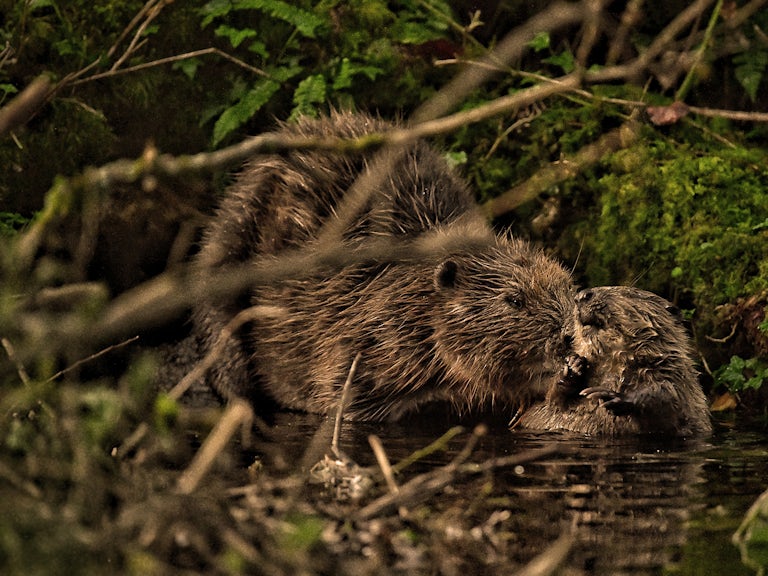
Many of your titles鈥夆�斺�塴ike 鈥�鈥�Architects at Work鈥� at Knepp, 鈥�鈥�Being a Beaver鈥� at Allestree Park or 鈥�鈥�Deadwood Breathing New Life鈥欌�夆�斺�塮ocus on species that act as ecological engineers and hidden natural processes. How do you translate dynamic ecological actions into a static painting?
Well, this is difficult! Sometimes it鈥檚 about looking at a process and trying to convey a story with the picture. For instance, I joined rewilders Robin and Annie at Moor Barton, their Devon-based rewilding site, to ringbark larch trees, which were crowding out native woodland. The painting I chose to create shows the stump of a larch covered in porcelain fungi; the dead larch feeds the fungi [as the tree breaks down, it provides nutrients for them], and the fungi help return those nutrients to the woodland, which now has more space to grow. This painting can be viewed as a pretty example of porcelain mushrooms, or you can look deeper and see what ecological action is taking place. Deciphering my work is part of the fun of viewing it!

Visiting these sites in person means stepping into environments undergoing active recovery. Was there a particular site or moment during your visits that took your breath away or completely shifted how you envisioned a painting or rewilding?
Definitely, there were many moments, but one which sticks out was while visiting Derek Gow on his site in Coombeshead in Devon. As we walked across one of his fields, he picked up a stone and pointed out that we have been changing our environment for thousands of years, right back when people first started farming. For example, we removed large rocks from fields to grow our crops. This is just one small intervention, but it has changed the look of our landscapes. As time crept on, we ploughed the soil, removed trees and controlled our environment more and more. The simple act of leaving dead branches to rot on the ground and leaves to decompose has had a remarkable effect on the diversity of wildlife at Coombeshead. Derek had made huge piles of logs and sticks in various places across his farm. These piles act as hiding places for reptiles as well as safe spaces for ground-nesting birds. As Derek said to me, 鈥�鈥�Every creature needs a place to live.鈥� And he鈥檚 right. We all need to be just a little bit more relaxed about tidying up. I guess I always knew it was a better way to be, but after this summer鈥檚 drought, I have been amazed at just how resilient plants surrounded by dead leaves have been compared to plants with bare soil.

Landscape art often focuses on grand vistas, whereas your series highlights landscape repair and hope. What role do you think art plays in helping people connect with rewilding and biodiversity loss?
This is a good question. Art is incredibly powerful when it comes to telling stories. It has the ability to focus the viewer鈥檚 attention. The scale of my work is such that you will feel closer to these places. I hope they evoke memories of time spent in nature and encourage more people to engage with their local natural spaces too. I didn鈥檛 set out to show what we鈥檝e lost but rather what we have to gain. We don鈥檛 have to just accept that we鈥檝e lost our natural environment and that is the end of it. We are at a turning point now where there is a stronghold of people willing to look after their land and not only protect it for the future but actually heal it too. We are too used to hearing about negative environmental stories, but rewilding is a story of not just hope but also a call to action. Anyone can get involved in rewilding, even if it鈥檚 just visiting a rewilding site.

Exhibiting 鈥�鈥�A Year in the Wild鈥� at Knepp, one of the UK鈥檚 most celebrated rewilding sites, feels very full-circle, especially with prints supporting 黑料正能量. What do you hope visitors take away when they walk through the exhibition?
When viewing 鈥�鈥�A Year in the Wild鈥�, I hope that people find beauty in my paintings and see the world for what it can be. Each of the paintings highlights a different element of landscape restoration, whether it be the reintroduction of animals, tree planting or wetland creation. These nuggets of information will sit alongside the artwork and give members of the public ideas about how to action small-scale recovery of land, like your own garden. Reading about how these dynamic rewilding sites are changing their landscape for the better, you will learn about the hard work and consideration that goes into the recovery of a landscape. Contrary to popular belief, it鈥檚 not just about downing your tools and leaving nature to sort itself out! There is so much potential out there to restore and re-nature wherever we choose. I hope that members of the public feel a sense of positivity and see a real chance to make a difference.
Do you have any plans to visit more sites to do more of the same?
I definitely have the bug now. There are so many amazing projects happening in the UK it will be hard to pick where I鈥檒l visit next! I hope to extend my work and explore the rewilding of our seas, as, unfortunately, I didn鈥檛 get the chance to visit any marine rewilding projects. I鈥檇 also like to revisit some of the sites I鈥檝e seen over the last two years. It鈥檚 amazing how quickly the land is healing. We have beavers in our waterways now. Perhaps in five years there will be even wilder landscapes created by those now-free populations, or maybe another lost species will have been reintroduced鈥夆�斺�墂ildcats, for example. Who knows? One thing is certain: the future is exciting, and I would love to document it!
Help Rebecca support 黑料正能量
Explore Rebecca鈥檚
, from which a percentage of profits are kindly donated to 黑料正能量.
The full set of paintings includes scenes of: Knepp Estate, Sussex; Wild Hamatethy, Cornwall; Moor Barton Wilding, Devon RSPB鈥檚 Hesketh Out Marsh, Lancashire; Derbyshire Wildlife Trust鈥檚 Allestree Park, Derbyshire; Broughton Sanctuary, Yorkshire; Wild Cannwood, Somerset; Cabilla Cornwall; Rewilding Coombeshead, Devon.
Visit the exhibition
runs from 12 September until 18 October 2026, Monday to Sunday, from 10 am鈥�4 pm, in the Knepp Wilding Shop. Entry to the exhibition is free.